Skip to content
Bifocal, the DBT app for iOS

Dialectical Behavior Therapy for iOS

A private DBT app for iOS: diary cards, Chain Analysis, no account.

Fill in your diary card, take a hard day apart in Chain Analysis, and find the right skill in seconds. Every DBT module, offline on your iPhone, with no account and no advertising.

Free download, optional £3.99 lifetime upgrade · no subscription

5.06 App Store ratings worldwide

iPhoneOn-device storageNo account

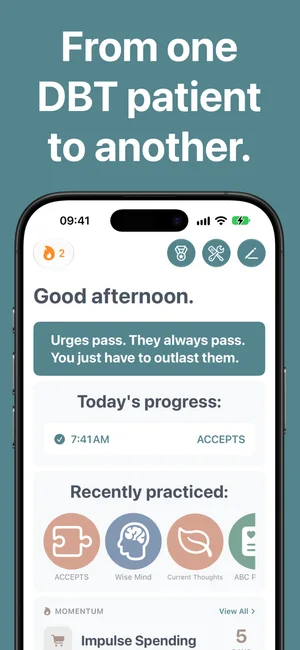
App Store screenshot of the Bifocal home screen, captioned From one DBT patient to another, showing today's progress and recently practiced skills

What happens after the card.

Most DBT apps stop at tracking. Bifocal carries the two pieces of work a therapist actually asks for between sessions: a Chain Analysis of the behaviour, and a diary card they can read without translation.

01 / Chain Analysis

Take a target behaviour apart, link by link.

A tick box tells you the behaviour happened. A chain analysis shows you how, and where a different choice was available.

  1. 01Vulnerability factors. The sleep, stress and events that set the day up.
  2. 02Prompting event. The moment the chain started.
  3. 03Links. Each point where a different choice was possible.
  4. 04Consequences. What followed, for you and for other people.
How to run a chain analysis

02 / Session export

A card your therapist already knows how to read.

Diary cards export as a facsimile of the official DBT diary card sheet, the layout used in session, not a screenshot or a spreadsheet.

  • One page. Emotions, urges, target behaviours and skills, in the order a therapist expects.
  • No retyping. The sheet comes from entries already saved on the device.
  • Nothing reformatted. Your week reads the same as the paper card it replaces.
How to use a diary card

Included with Bifocal Pro

High distress

For the ten minutes when thinking is not available.

High-distress skills are the ones you reach for at 2am with no signal. They are written out step by step, and they sit above the point where reasoning stops working.

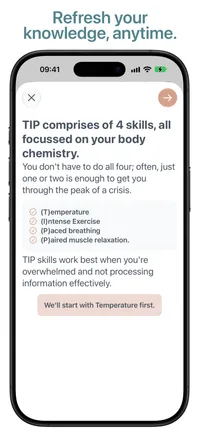
  • TIPP, in order. Temperature, intense exercise, paced breathing and paired muscle relaxation, each explained and walked through on its own page.
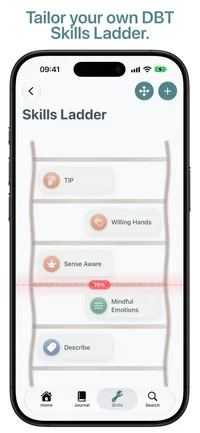
  • A Skills Ladder you arrange. Add your own skills and drag them into the order you would actually use, from the ones that need a clear head down to the ones that work when you have nothing left.
  • A 70% line. The point where you stop negotiating with yourself and switch to the body-first skills. It is drawn on the ladder, so the decision is already made when you need it.
Skills Ladder with TIP, Willing Hands and Sense Aware above the red 70 per cent line, and Mindful Emotions and Describe below itTIP skills page explaining temperature, intense exercise, paced breathing and paired muscle relaxation

Features

The daily card, an exercise behind every skill across all four DBT modules, the goals you are working towards, and the record that ties them together. All of it works offline.

A diary card for every day

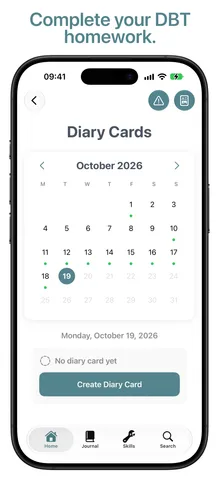
Rate emotions and urges, record target behaviours and tick the skills you used. Cards are timestamped, grouped by week and marked on the calendar, so a missed day is easy to spot.

Diary Cards calendar for October 2026 with a dot on every completed day and a Create Diary Card button for the 19th

Exercises that walk you through a skill

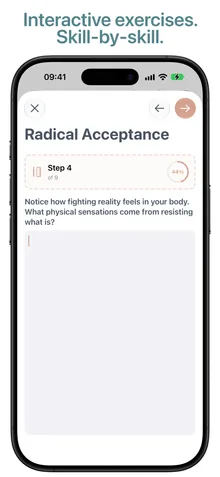
Each skill opens as a guided exercise: one prompt at a time, somewhere to write, and a progress ring. Leave halfway through and the step is waiting where you left it.

Radical Acceptance exercise at step 4 of 9, with a prompt about noticing resistance in the body and a progress ring showing 44 per cent

See what you're actually practising

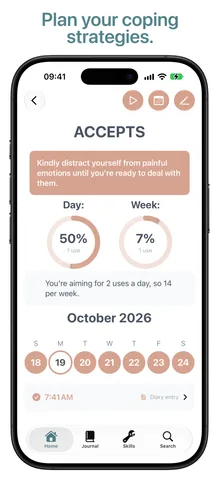
Set a daily target for a skill and the day and week counters fill as you use it. Every use is dated on a calendar, so streaks and quiet weeks are both visible.

ACCEPTS page showing 50 per cent of a daily target and 7 per cent of a weekly target, with uses marked on an October calendar

Life Worth Living goals

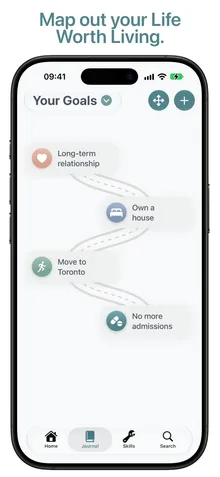
Keep the reasons the work is worth it in view. Long-term goals are mapped out in the Journal, next to the entries and wins that move you towards them.

Goals map in the Journal with nodes for a long-term relationship, owning a house, moving to Toronto and no more admissions

Find a skill in seconds

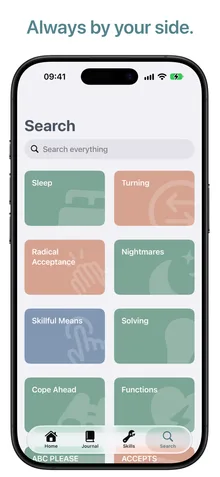
Search skills and concepts offline, and land on a page you can act on, not a reading list for later.

Search screen with a Search everything field above cards for Sleep, Turning, Radical Acceptance, Nightmares, Cope Ahead and ACCEPTS

Review the week, not just the day

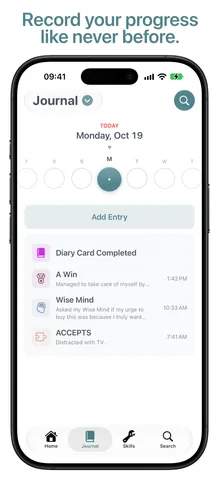
Journal entries, wins and skills share one timeline. Analytics splits the same data into time patterns, emotions, goals and engagement, and Effectiveness Rankings shows which skills actually worked.

Journal screen for Monday 19 October listing a completed diary card, a win, a Wise Mind entry and an ACCEPTS use, each timestamped
September 2026
“This app is so genuinely good. I've been using it for about 1.5 years and have really benefitted from it. It's been consistently updated by the developer and they welcome feedback, if something seems like it's not working or you have a suggestion. You don't find wellness apps like this often. it's not exploitative. it's hand crafted and thoughtful. it's evidence based. it just works. thanks for the continued passion you put into this project. i love opening it up whenever there's an update to see what's been added.”
Extremely worth the one time purchase · Australia
January 2026
“Really realistic and well informed exercises”
Really helpful · United Kingdom

Ratings are pooled from every App Store storefront where Bifocal is available, so the total can differ from the one your local App Store shows. Reviews are quoted from the English-language listings.

Built for privacy.

Spec / 001

No accounts and offline-first storage, with analytics off unless you turn them on. Built by a fellow DBT patient for the space between sessions.

Accounts
Not required. No email address, no sign in, no profile. iCloud only if you want it.
Network
Not required. Diary cards, skills and exercises work with no connection.
Analytics
Opt-in only. Anonymised usage signals through TelemetryDeck if you turn them on. No advertising and no cross-app tracking.
iCloud
Optional. If you turn it on, entries sync to your own private iCloud account.

FAQ

Short answers to the questions that come up before installing.

Is Bifocal a replacement for therapy?

No. It is a self-management tool for the time between sessions. Keep working with a clinician, and if you are in immediate danger contact your local emergency number.

Do I need an account?

No. There is no sign up, no email address, and no profile. The app opens straight into today’s card.

Where is my data stored?

In a local database on your iPhone as well as your own private iCloud account.

What analytics does Bifocal collect?

Only what you agree to. Usage analytics are off by default and, if you turn them on, send anonymised signals through TelemetryDeck to help improve the app. There is no advertising and no cross-app tracking, and entries stay on your device and in your own iCloud.

Does it work offline?

Yes. Diary cards, skills, and past entries all work with no network connection.

How much does it cost?

Free download, optional £3.99 lifetime upgrade. There is no subscription: the download is free, and Pro is a single payment that unlocks the paid features for good. The App Store listing is the source of truth for the current price in your country.

Does Bifocal include Chain Analysis?

Yes. Chain Analysis works through the vulnerability factors, the prompting event, each link in the chain and the consequences, and keeps the analysis with that day’s diary card.

Can I export a diary card for a session?

Yes. A diary card exports as a facsimile of the official DBT diary card sheet, so the page you take to a session is the layout a DBT therapist already reads.

Learn the skills

Every DBT guide

What each skill is for, how to use it on a hard day, and how to keep a diary card a therapist can read. Written alongside the app, updated when the practice changes.

All guides

Choosing an app? Best DBT apps for iPhone compares diary cards, Chain Analysis, privacy and cost across seven apps.

DBT skills glossary

Look up a skill.

Twelve core skills from the four DBT modules — mindfulness, distress tolerance, emotion regulation and interpersonal effectiveness — each explained with when to use it, how to do it and a worked example.

All DBT skills
Bifocal banner with the app wordmark and four circular icons for its skill categories